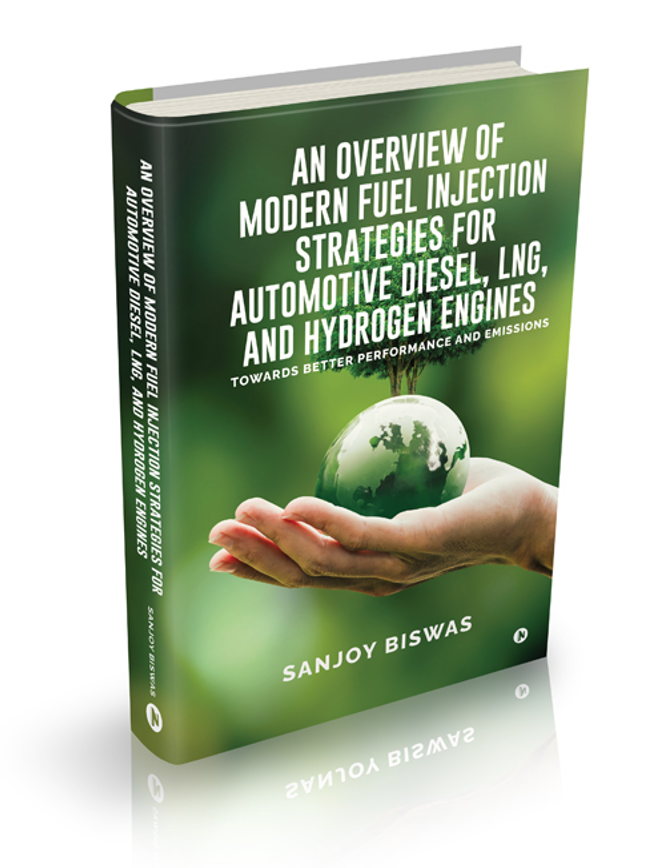
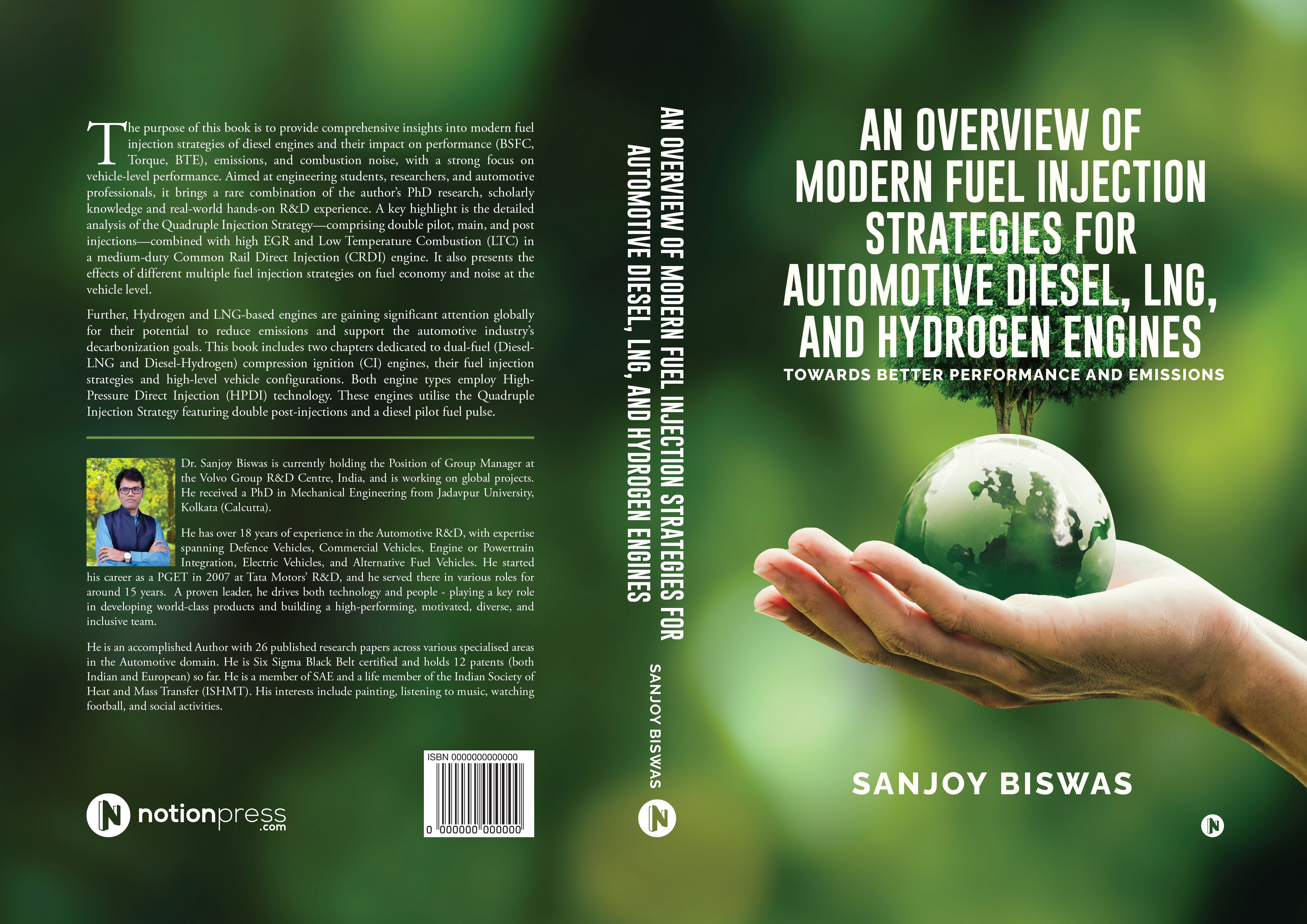
An Overview of Modern Fuel Injection Strategies for Automotive Diesel, LNG, and Hydrogen Engines: Towards better Performance and emissions
A technical book by Sanjoy Biswas
An Overview of Modern Fuel Injection Strategies for Automotive Diesel, LNG, and Hydrogen Engines: Towards better Performance and emissions
Book Details:
- ASIN : B0G23FD625
- Publisher : Notion Press
- Publication date : 13 November 2025
- Language : English
- Print length : 190 pages
- ISBN-13 : 979-8901365670
- Item Weight : 445 g
- Dimensions : 15.84 x 1.7 x 23.46 cm
- Country of Origin : India
- Importer : Atlantic Publishers and Distributors (P) Ltd., 7/22, Ansari Road, Darya Ganj, New Delhi - 110002 INDIA, Email – customercare@atlanticbooks.com, Ph – 011-47320500
- Packer : Notion Press Media Pvt Ltd | No,50, Chettiyar Agaram Main Road, Vanagaram, Chennai - 600095 | URL: https://notionpress.com/store | Mail Id: orders@notionpress.com
- Generic Name : Books
Author Sign Copy : 425

About The Book
Synopsis
The German engineer Rudolf Diesel invented and patented the
first compression ignition (CI or Diesel) engine in 1892. Since then,
these engine technologies have continued to evolve to meet the
performance requirements and emission standards. The use of diesel
engines has expanded into various applications compared to Spark
Ignition (SI) or Gasoline engines due to better mileage, part-load
efficiency, and durability, despite inherent issues like combustion noise
and soot emissions.
Now, Internal Combustion Engine (ICE) emissions, fuel economy,
and noise significantly impact environmental pollution, especially with
on-road or automotive ICE. Therefore, the challenges are multiple for
engine developers and R&D engineers, particularly for diesel engines,
as they must comply with strict emissions standards [e.g., BS-IV, BSVI,
or Real Driving Emissions (RDE)] while meeting mandated fuel
economy norms [such as heavy-duty fuel economy (HDFE) or corporate
average fuel economy/efficiency (CAFE)]. Fuel economy standards
aim to reduce the carbon footprint or CO2 emissions (measured in
gm/km) to combat Global Warming by improving fuel consumption
compared to previous norms. Currently, combustion noise (CN/
radiation) of diesel engines has garnered significant attention because
it causes discomfort among passengers and pedestrians, in addition
to contributing to noise pollution. Exhaust after-treatment systems
play a crucial role in meeting emission regulations but have a limited
impact on fuel efficiency, torque, brake thermal efficiency (BTE), and
combustion noise (CN). In-cylinder emission reduction methods play a
crucial role in shaping combustion characteristics, directly influencing
both engine efficiency and the formation of pollutants. Moreover, the
combustion behaviour of diesel engines depends on several factors,
including the design of the combustion chamber, turbocharger,
Exhaust Gas Recirculation (EGR), injector nozzle, fuel injection strategy,
and its parameters—such as Fuel Injection Pressure (FIP), Injection
Timing, Start of Injection (SOI), injection dwell, rate shaping, and
fuel quantity. EGR is a proven method for reducing in-cylinder NOx
emissions; however, it can adversely affect soot emissions. Increasing
EGR percentage, depending on engine size and complemented by
measures such as adjusting fuel injection characteristics, compression
ratio, and air intake, is the simplest approach to achieve lowtemperature
combustion (LTC), which can simultaneously reduce NOx
and particulate emissions.
Multiple fuel injections involve splitting the total injected fuel
quantity of each cycle into multiple pulses, thereby achieving
better control of spatial fuel delivery and improving air usage in the
combustion chamber. In Multiple injections, mainly three types of
injection pulses are there, namely a) pre-injections (or pilot injections),
b) main injection, and c) post/After-injections. It is known that the
combustion process of a DI diesel engine is divided into four phases:
ignition delay, premixed burning, diffusion/mixing-controlled
combustion, and late burning. The Multiple Injections Strategy plays a
crucial role in combustion processes, which ultimately control ignition
delay, the premixed and diffusion-controlled phase. Lastly, it controls
the combustion chamber inside heat release rate (HRR), combustion
pressure, and bulk gas temperature. These are the enablers to control
BSFC, Torque, emissions, and combustion noise. Therefore, fuel
injection strategy plays a key role in simultaneously reducing emissions
and noise without penalising fuel economy due to its better control of
the combustion process.
The purpose of this book is to provide comprehensive insights into
modern fuel injection strategies of diesel engines and their impact on
performance (BSFC, Torque, BTE), emissions, and combustion noise,
with a strong focus on vehicle-level performance. Aimed at engineering
students (Mechanical and Automobile), researchers, and automotive
professionals, it brings a rare combination of the author’s PhD research,
scholarly knowledge and real-world hands-on R&D experience. A key
highlight is the detailed analysis of the Quadruple Injection Strategy—
comprising double pilot, main, and post injections—combined with
high EGR and Low Temperature Combustion (LTC) in a medium-duty
Common Rail Direct Injection (CRDI) engine. It also presents the effects
of different multiple fuel injection strategies on fuel economy and noise
at the vehicle level.
Further, Hydrogen and LNG-based engines are gaining significant
attention globally for their potential to reduce emissions and support
the automotive industry’s decarbonization goals. This book includes
two chapters dedicated to dual-fuel (Diesel-LNG and Diesel-Hydrogen)
compression ignition (CI) engines, their fuel injection strategies and
high-level vehicle configurations. Both engine types employ High-
Pressure Direct Injection (HPDI) technology. These engines utilise the
Quadruple Injection Strategy featuring double post-injections and a
diesel pilot fuel pulse.
The book is arranged in eight Chapters and four sections.
Chapter One covers the basic insights of the Diesel engine, including
cycles, combustion mechanism, emission formation, and emission
control technologies. Chapter Two focuses on the fuel injection
system and strategies, providing a summary of existing research
on fuel injection strategies, and an outline of the objectives. While
Chapter Three focuses on the study objectives, experimental setup,
procedure, engine specification, instrumentation details, vehicle
details, and noise measurement schematic and method. This
also shows the uncertainty analysis of the measurement. All the
information provided in this chapter applies to all experimental
investigations (Chapters Four to Six). Chapter Four is to assess three
different multiple injection strategies at different loads and speeds.
An estimation was done for soot/smoke emission, BSFC, torque,
and combustion noise. Another study in Chapter Five evaluates
the effectiveness of quadruple injections over triple injections with
different SOI Main injection timing experimentally at wide operating
conditions.
Furthermore, Chapter Six represents a comprehensive assessment
of the quadruple injection strategy (epMa) over two different (pMa,
eMa) triple injections at fixed main injection timing (SOI) and wide
operating conditions on the Rig and vehicle level for fuel economy,
emissions, and noise. Chapters Seven and Eight cover the insights
of HPDI-LNG engines and the HPDI-H2 engines, as well as their fuel
injection strategies and challenges. In the last chapter (Chapter Nine),
the author summarises the studies and future study scope in this
domain. Furthermore, a Questionnaire section is available in this book.
Sanjoy Biswas, PhD
What Readers Are Saying
Deified
Not every book I review is something you read for comfort. Sanjoy Biswas's fuel injection strategies book is dense, technical, and clearly written by someone who spent real time in a lab running these tests. I found the hydrogen engine chapter especially interesting given where the automotive industry is headed. If you're in engineering or research, check out my full thoughts.
Deifiedbooks
Diesel. LNG. Hydrogen. This book covers all three, and honestly, I wasn't ready for how specific the research gets. Full review on the blog
Radcliffebureauhq
Some books hit you emotionally. This one hit me with data tables and I kind of loved it anyway. Review is live now.
Priya Srivastava
This is basically a condensed version of a PhD thesis and it reads like one, lots of tables and test data. I liked that the author admits where his results fell short of emission targets instead of just spinning everything positive. some chapters assume you already know test methods like ESC and ETC which slowed me down a bit since I had to look those up. overall solid if you're in automotive engineering, not for casual readers.
Deified
Diesel. LNG. Hydrogen. This book covers all three, and honestly, I wasn't ready for how specific the research gets. Full review on the blog.
Deifiedbooks
Diesel. LNG. Hydrogen. This book covers all three, and honestly, I wasn't ready for how specific the research gets. Full review on the blog.
Bookreviewsforum
Some books hit you emotionally. This one hit me with data tables and I kind of loved it anyway. Review is live now.
Deified Publications's Review
his was a change of pace for me, a full technical book on fuel injection strategies for diesel, LNG, and hydrogen engines. I liked how specific the research gets, especially the chapter comparing quadruple injection against triple injection setups on an actual test engine. The author doesn't oversell his findings either, he flat out says the best strategy still missed the NOx target he was aiming for. That kind of honesty is rare in research writing. Dense read, but rewarding if you're in the field.
Payment QR Code
Scan this QR code to make payment.